



On May 1, we honor the labor movement's struggles and achievements for dignity, rights, and better working conditions. Around the world, members of WMCW movements join workers in celebrating the gains won through daily struggle. We also raise our voices in support of decent work and a more just society.
Work is how human beings earn their daily bread and participate in caring for creation. Exploiting or enslaving through work opposes God’s plan for humanity. We know that rights are never definitively secured; they require constant vigilance and commitment to preserve gains and open new horizons of justice.
As the encyclical Laborem Exercens reminds us, work is "a key, and probably the essential key, to the entire social question" (3). For us, work remains a place of dignity and fraternity where everyone is called to participate in the work of creation and build a more humane society.
As we celebrate International Workers’ Day 2026, we turn our attention to the workers of India. Despite a legal framework intended to protect their rights, their working conditions are deteriorating. This serves as a reminder that international solidarity and perseverance in the struggle are indispensable.
India is a land of unity in diversity. But the country also faces several social problems and challenges. This social problem frequently affects millions of informal workers and also demands urgent attention from policy makers. Understanding these social problems affecting India helps in fostering a just and fair society. Here are the major social problems from the four comprehensive Labour Codes in India right now
India has consolidated 29 central labour laws into four comprehensive Labour Codes, and the Union government says to simplify regulations, enhance worker welfare, and modernize the labour ecosystem.
But the four Labour Codes in India have been criticized for reducing union power, diluting job security, and providing limited social security for informal workers.
- Erosion of Collective Bargaining and Union Power
The Industrial Relations Code makes it harder for workers to strike or protest. Strikes now require a 60-day notice period and, in some cases, support from 75% of workers, which limits the ability of trade unions to negotiate effectively and reduces their bargaining power.
2. Dilution of Job Security
The threshold for government approval for layoffs and retrenchments has been raised from 100 to 300 employees, allowing firms greater flexibility to hire and fire workers. While this promotes business flexibility, it reduces job security for employees, particularly in medium-sized enterprises.
3. Limited Social Security for Informal Workers
Although the Code on Social Security extends benefits to gig and platform workers, the coverage remains inadequate for India’s informal workforce, which constitutes around 90% of the labor market. Contribution rates and benefit designs are often left to future rules, creating uncertainty and leaving many workers without meaningful protection.
4. Stricter Compliance May Be Challenging for Small Enterprises
While the codes simplify laws, the dual role of inspectors as facilitators and enforcers may weaken enforcement. Small and medium enterprises may still face challenges in understanding and implementing new compliance requirements, especially in states that have not yet notified rules. - Potential Gender and Worker Welfare Gaps
Certain provisions, such as unpaid care work, are excluded, which disproportionately affects women. Additionally, vague rules for gig workers and delegated legislation may lead to divergent standards across states, creating inconsistencies in worker protection. - Strikes and Industrial Action Restrictions
The codes impose a 14-day notice, 60-day cooling-off period, and, in some cases, require a high percentage of worker support for strikes. This makes industrial action more difficult, potentially limiting workers’ ability to negotiate for better conditions.
While the Labour Codes aim to streamline regulations and improve ease of doing business, their demerits include weakened union influence, reduced job security, limited social security for informal workers, and potential enforcement challenges, which may affect the balance between worker rights and industrial flexibility in India.
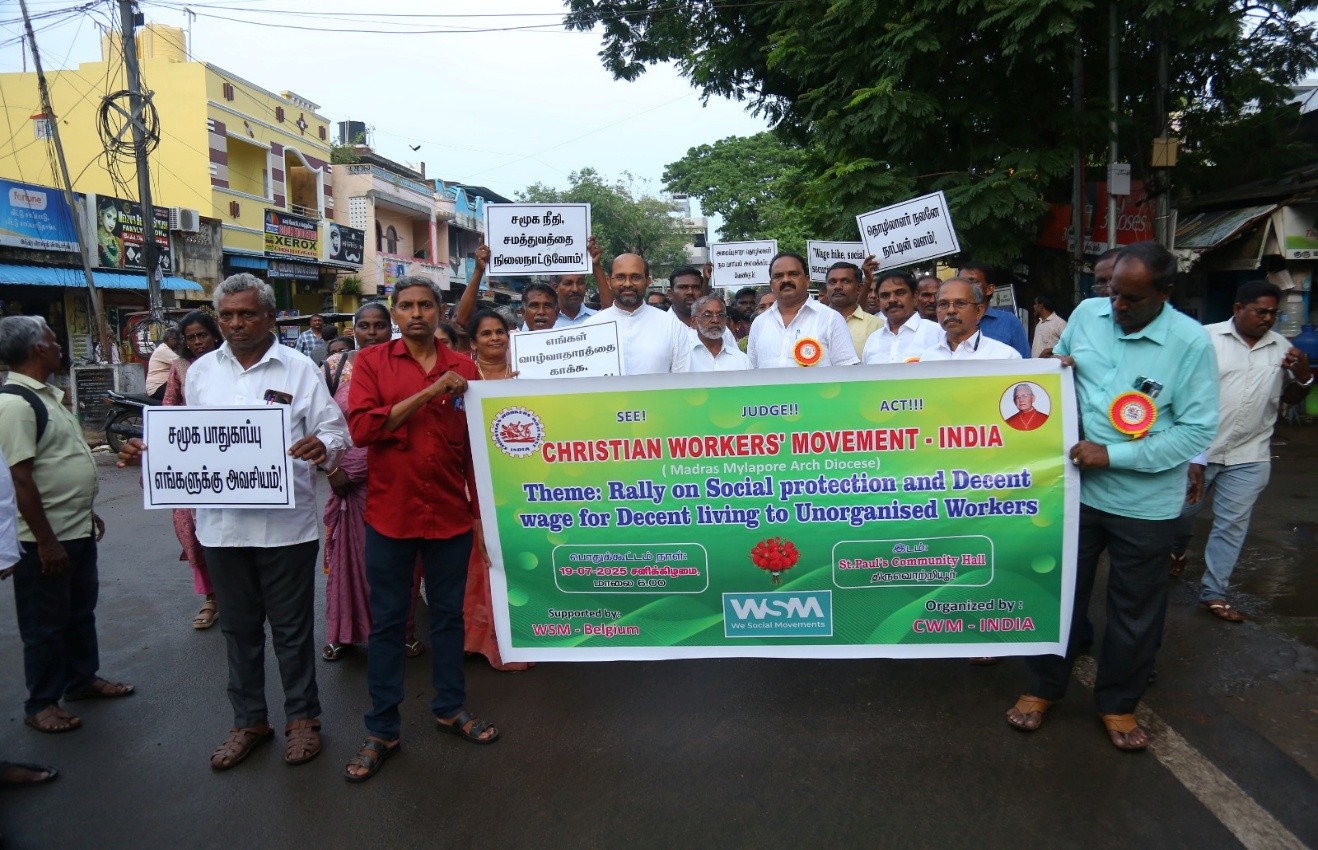
So Christian Workers' Movement India opposed the union government by demonstration, workers' rally, and Public meeting with policy makers, provide memorandum, and Road roko with Street plays to get back the 4 labour codes and implement the previous 29 labour laws.
And in your country, what are the key issues that need to be addressed in order to move toward decent work that respects every individual, regardless of gender or age?
Written by:
G.Augustin MangalaRaj,
Council Member for South Asia.
